Gazeley is a village where the oldest houses and the newest stand a few minutes’ walk apart. Clustered around the road junction and the church in the middle of the village are buildings that go back to the Middle Ages. Much of the rest is far younger: parish records count 116 inhabited houses in 1951 and 260 by 1981, so the number of homes more than doubled in thirty years.
Making more of a post-war house
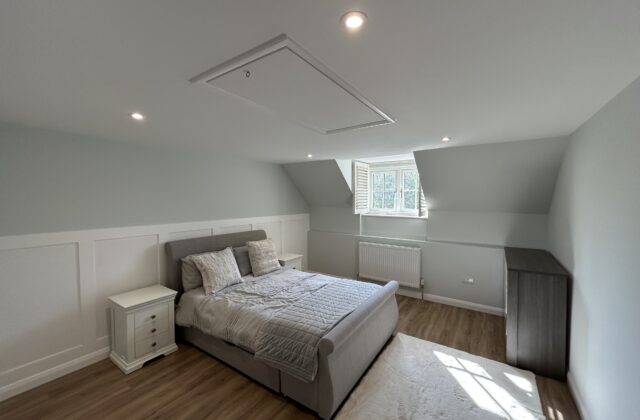
Houses from those decades are usually sound, but many have small kitchens, single garages and roof spaces that do nothing. They respond well to a single-storey rear extension, a kitchen moved into a bigger space, or a garage conversion that adds a study or a playroom without touching the garden.
The ground matters. Soil surveys for the parish describe loam over clay, with some chalky clay subsoils. Clay moves as it wets and dries, and nearby trees make that worse, so foundations for an extension are designed around what is actually under your house, and building control will want to see that they are.
The old houses of Gazeley
There are nine listed buildings in the parish. The finest is the Church of All Saints, Grade I, largely early 14th century work in flint rubble with stone dressings. Its chancel roof is carved with angels, human faces, animals and foliage. On The Street, Nos 3 and 5 were once a single 15th or early 16th century timber-framed house with a cross-wing: one half has since been cased in painted brick, the other is rendered and has a jettied upper floor on four brackets. The Manor House, Needham Hall at Needham Street and Gazeley Stud House are also listed, and one house in the village was converted from a windmill.
Gazeley has a racing side as well. Gazeley Stud sits close to the church, and its barn, 150 metres north west of All Saints, is listed in its own right. The farmstead at Desning Hall, away from the village, has a listed barn too. The Icknield Way Path, a long distance route of about 110 miles, passes through the village.
Work on a timber-framed house like these is slow and careful. Frames often hide behind later brick or render, so we open up gently to see what is there before deciding on any repair, and listed status means consent from West Suffolk Council for most changes, inside as well as out.
Who we are
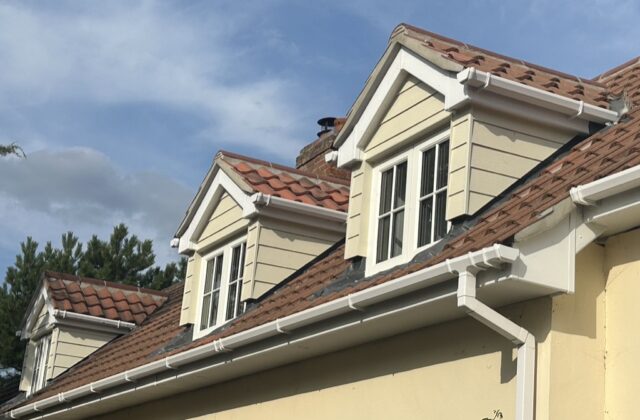
A&F Building Services is a family business set up in 1993, covering Newmarket and the villages around it. We keep design, trades and site management under one roof, and we are fully insured. Our nearest published project is in Newmarket: a new pitched dormer clad in Hardie board with a farmhouse pantile roof.