White Hall in Little Wilbraham shows how an English farmhouse changes over four centuries. It was built as a timber-framed, three-bay, lobby-entry house in the late 16th or early 17th century. A projecting front wing with a porch and an upper room was added around 1620, a rear kitchen wing came in the late 17th or early 18th century, and in the 19th century the back wall and a gable end were cased in yellow brick. Inside there is still a mid 17th-century oak fireplace surround. It is Grade II listed, and it is a good guide to what many older homes in the parish are like underneath.
A street of two halves
The village runs along a curving east to west street about a quarter of a mile north of the brook. By 1800 it had two parts: Church End to the east, once called Green Street, and a line of farmhouses and cottages to the west on what was Hawk Street. The 17th and early 18th-century houses that survive are mostly timber-framed, some partly cased in brick and some still thatched. The Hole in the Wall, the village pub, is a three-bay house probably of the mid 16th century. At the east end, the Church of St John the Evangelist, Grade II*, dates mainly from the mid 13th century.
A frame that has been cased in brick in one century and patched in another can hide all kinds of things. Where brick has been added over timber, the joint between the two is worth watching, and any repair should use brick and mortar that suit the original. Our brickwork and maintenance services cover that kind of work.
Six Mile Bottom
The parish reaches south-east to Six Mile Bottom, a settlement that grew up later than the main village. It had 14 to 17 dwellings in 1851 and 27 by 1871. The Lodge there is a substantial Regency house, built by 1802. Around 1975, the oldest row of 10 cottages at Six Mile Bottom was replaced with bungalows, and in the main village new houses went up between 1960 and 1975 at the west end of the street and near Rectory Farm.
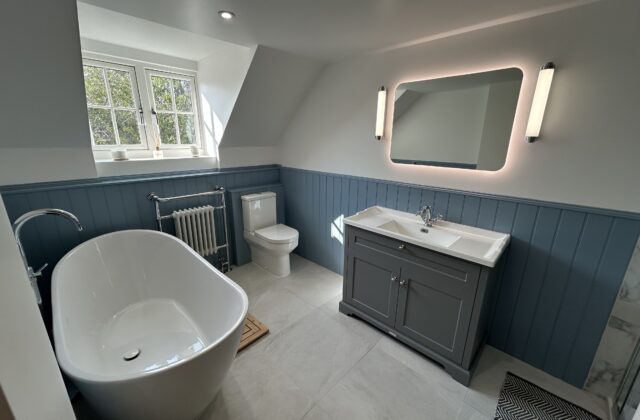
Homes from those years are now 50 to 65 years old, and many are ready for a new bathroom or a wider refurbishment. For a sense of finish, our Newmarket bathroom combines a freestanding oval bath, slate-blue panelling and cottage casement windows.
Planning and ground
Little Wilbraham is in South Cambridgeshire, and its conservation area was designated on 10 April 1986. Inside the boundary, and on any listed house, more of your plans will need the council’s agreement. The parish sits on Middle Chalk, with Totternhoe Stone and Cambridge Greensand in the north-west and river gravels near the brook and the village itself. Around 400 people live here. For anything from a leaking gutter to a full refit, A&F Building Services is fully insured and has been at it since 1993.