Skip to content
A&F Building Services
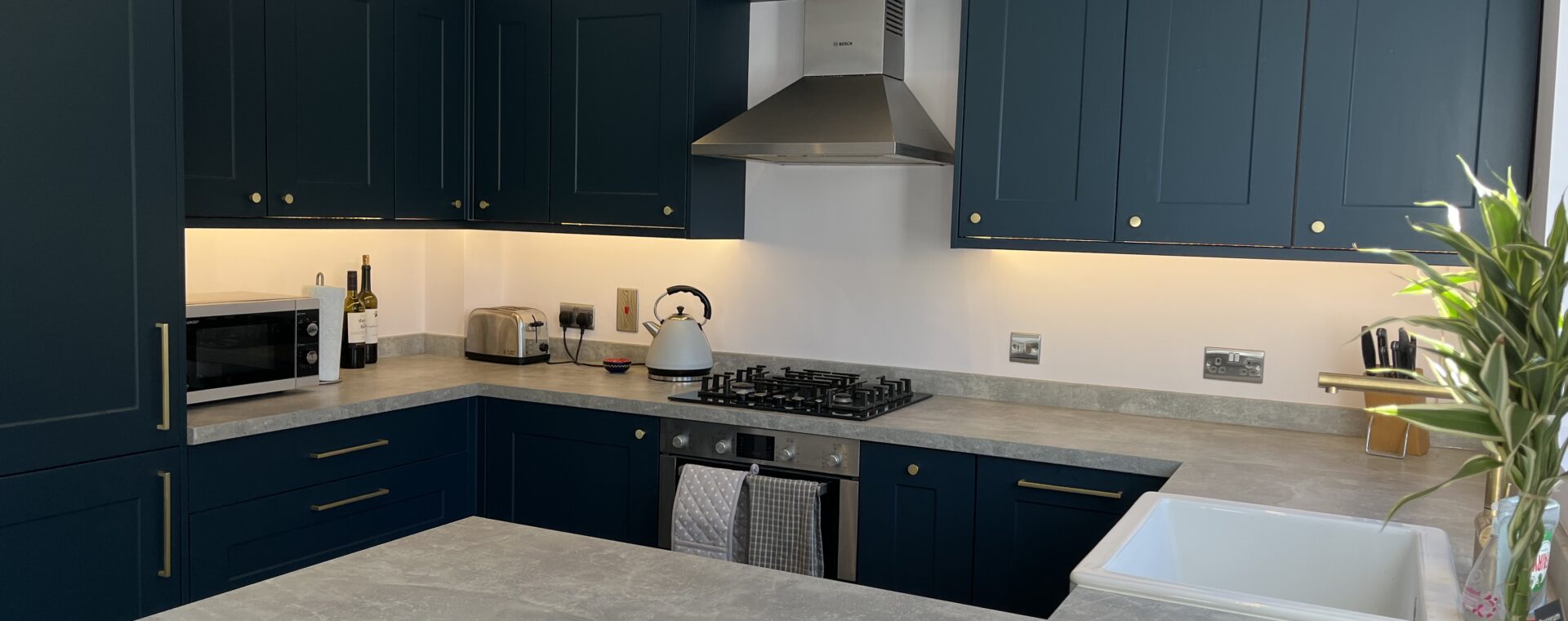
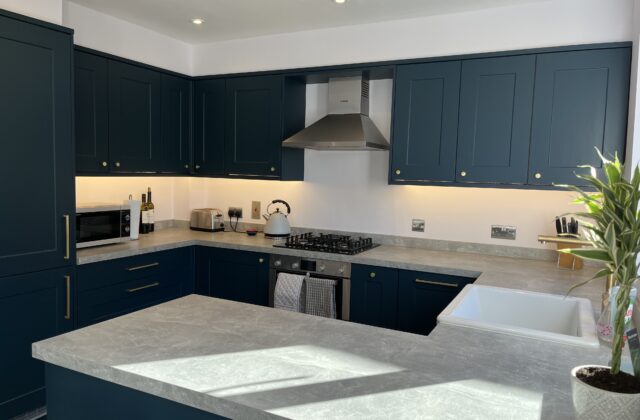
Navy blue shaker kitchen with brass hardware, concrete-look worktops, gas hob and stainless steel chimney extractor
Areas We Cover

Builders in Histon

Extensions, refurbishments and careful repairs for Histon homes, from timber-framed cottages by the Green to the houses built for Chivers workers.

Most people in Histon would say the village starts at the Green, where the brook widens beside the old pump. It used to be far bigger. The Victoria County History describes a large oval green, of which only the eastern third is left, bounded by the brook on the north and by what is now the High Street on the south. The oldest houses in the village still gather around it, and it is the right place to begin if you want to understand what you are building onto.

Older than they look from the pavement

A lot of Histon’s historic houses hide a timber frame behind a later face. The Olde House, just south of the Green on Station Road, is an early 16th and 17th century timber-framed house cased in red brick, and it is listed Grade II*. Number 5 The Green has a 17th and 18th century frame, partly exposed under rough-cast render and partly encased in gault brick during the 19th century. Stone Corner Cottage keeps a 14th century hall house at its core.

When a wall is opened up in a house like these, an older structure often turns up inside it, and the repair needs to work with the frame. That means patient carpentry, and new brickwork chosen to sit comfortably beside red or gault brick that has weathered for two centuries.

Jam, the railway and the co-operative houses

The railway opened through Histon in 1847, and three years later Stephen Chivers bought an orchard next to the line. The family’s jam factory followed in 1874, and by 1939 it employed up to 3,000 people. John Chivers was behind the Histon Co-operative Homes Society, which in the 1920s and 1930s built the estate south of the railway and helped many of the firm’s employees buy their homes. Passenger trains stopped in 1970, and the trackbed now carries the Cambridgeshire Guided Busway.

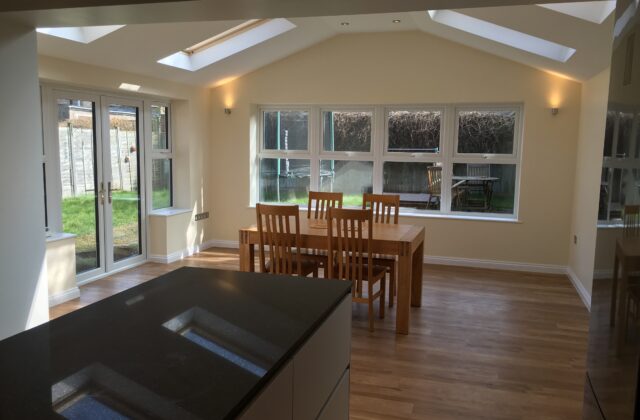
Growth did not stop with the factory. After 1957 Histon and Impington were chosen as one of six settlements around Cambridge to take much of the city’s expansion, and houses across the two parishes doubled from about 1,200 in 1951 to almost 2,400 in 1981. Those post-war family homes are where the practical questions come up: a single-storey rear extension for a bigger kitchen, or a garden room to work from.

Church Street, the Green and the planning side

St Andrew’s on Church Street is Grade I listed: a cruciform church whose chancel was restored by Sir George Gilbert Scott in the 1870s. Around it, and around the Green, there is a run of listed houses, including several on The Green itself and on Church Street. The conservation area here was first designated in 1974 and has been extended twice since, covering the village centre and Station Road.

On a listed house, or one inside the boundary, fewer alterations count as permitted development, so ask South Cambridgeshire District Council for a view while the drawings are still rough. A&F Building Services has been building since 1993, is fully insured and runs the whole project with its own people, so the conversation about what is allowed and the work on site stay with one firm.
What Our Clients Say

★★★★★ Rated 5.0 out of 5 from 5 Google reviews

See More Reviews
★★★★★
“We have been very satisfied with the professionalism of Andy and his team in refurbishing our two rental properties. They combine attention to detail, great workmanship, patience and good sense of humour. We do not hesitate to recommend…”
Mr & Mrs Baker
Google review · a week ago
★★★★★
“Andy and team created a new utility room and kitchen snug area for us, and we’re delighted with the result. The quality of their work was excellent, and they delivered exactly what we wanted. They worked efficiently, kept everything clean…”
Rosie Galpin
Google review · 2 months ago
★★★★★
“Reliable and trustworthy, excellent builders who completely renovated my newly purchased but tired looking 2 bedroom property from top to bottom into a high spec modern home. My visitors comment on the quality of workmanship and the…”
Detty Michell
Google review · 2 months ago
★★★★★
“Well worth the wait! We have used A&F for a number of projects (block paving, new bathrooms, decking, new roof) and - most recently - a garden studio. Andy pays meticulous detail to getting things right and it shows in the end product…”
Graham Lloyd
Google review · 8 years ago

Reviews from Google Maps

Building in Histon: FAQs

Our cottage near the Green turned out to have a timber frame under the brick. Does that change the work?

It often does. Several houses around the Green were built as timber frames and cased in brick later, so the walls may not behave like solid masonry. Before any opening is made or anything is fixed to the frame, it is worth finding out what condition the timbers are in and how they carry the roof. If the house is listed, the council will want to know about changes to the historic fabric as well.

Is our 1930s house south of the Busway one of the Chivers co-operative homes?

It may be. The Histon Co-operative Homes Society, set up with John Chivers' involvement, built the estate south of the railway in the 1920s and 1930s, and the railway line is now the Busway. Your deeds may name the society as an early owner. Whatever its origins, a house of that age is worth looking over carefully, walls, roof and drainage included, before an extension is designed.

Histon is so close to Cambridge. Which council deals with our application?

Histon sits just north of the city across the A14 and comes under South Cambridgeshire District Council, not Cambridge City Council. The two councils share a planning service, Greater Cambridge Planning, which publishes the conservation area boundary maps for Histon and Impington on its website. That is a useful first check if you live near the Green, Church Street or Station Road.